ChatGPT reply to comments: the prompts that work and where it breaks
ChatGPT and Claude write good replies when you give them your facts and your tone. They do not see your comments, post anything or moderate. How to get the drafting right, and when an agent is the better tool.

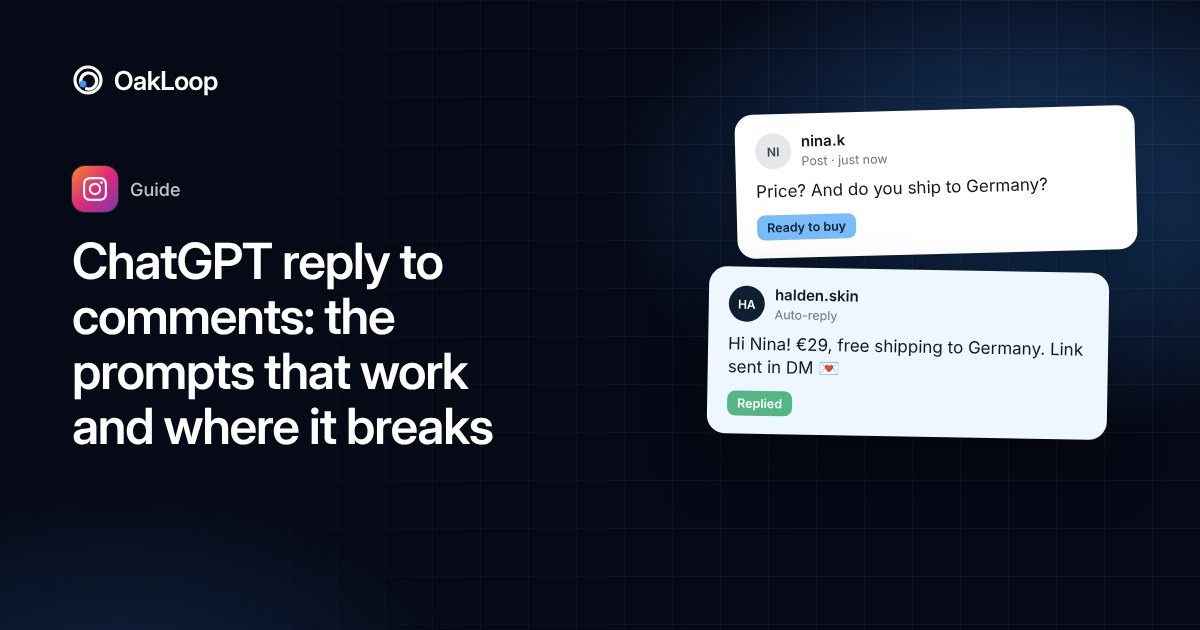
What ChatGPT can do with your comments
A ChatGPT reply to comments is a draft: you paste a comment, ChatGPT suggests an answer, and you check it and post it yourself. That is useful, and it is a different thing from an Instagram auto reply, which answers on the platform without anyone copying anything. Everything below applies to Claude as well.
Used as a drafting assistant, a chat model is good at:
- finding the right tone for a delicate reply, such as a late parcel or a refused refund;
- offering three versions of the same answer, so your replies do not all sound alike;
- replying in the commenter's language, or checking a reply you wrote in a language you know less well;
- summarising a long thread before you step in;
- turning your returns policy into a short answer you will reuse.
What it cannot do on its own: see a comment you did not paste, know anything about your shop you did not tell it, post, hide or delete.
Can ChatGPT reply to Instagram comments by itself?
Not from the chat window. ChatGPT has no access to your Instagram account unless something connects the two, and without that connection it cannot post anything. The connection people build is an automation: platforms such as Make publish templates that send each new Instagram comment to OpenAI and post the generated reply automatically (template checked on 21 October 2026).
That works, and it makes you the owner of a small agent. You write the prompt, keep the facts it answers from up to date, decide what happens when it does not know, and accept that it posts without review. A reply template is built to reply: hiding spam, deleting a scam link or spotting a complaint that is turning into a pile-on is a different job.
Prompts that work
A good prompt has four parts: who is speaking, the facts it may use, the rules, and the comment. Leave one out and the model fills the gap with something plausible.
One comment, three options
You reply to comments for [brand], which sells [products] in [countries]. Tone: [warm and direct, informal, no slang]. Use only these facts: [delivery times by country, returns window, sizes, current offer and its end date]. Rules: two sentences at most, no promise the facts do not support, and if the answer is not in the facts, say we will check and invite them to send us a DM. Comment: "[paste]". Give me three options.
The unhappy customer
This customer is unhappy: "[paste]". Write a public reply that thanks them, acknowledges the problem in one sentence without admitting a fault we have not confirmed, and moves the conversation to DM with a clear next step. No arguing, no discount unless I add one, under 40 words.
If you only need a starting point for this kind of reply, our free negative comment reply generator builds options from templates, without an AI account.
A batch to sort
Here are 30 comments from one post, one per line. Label each one: question, complaint, praise, spam or other. Draft replies for the questions and complaints only, using the facts above. List separately any question you could not answer from the facts.
Your voice, extracted
Here are 15 replies we wrote and liked. Describe our tone in five rules (formality, length, emojis, words we use, words we avoid), then rewrite this draft so it follows them: "[paste]".
The last rule of the first prompt matters most. Without an explicit way out, a model asked about delivery will produce a delivery time, and it will sound sure of it. OpenAI's own help centre says ChatGPT can make up information and may sound confident even when it is wrong (checked on 21 October 2026).
How to give it your brand voice and product facts
Pasting the same context into every chat is where most of the time goes. Write it once and store it where the assistant reads it automatically.
A one-page voice sheet
Formality (tu or vous if you sell in French), sentence length, emoji policy, the words you use and the words you never use, how you sign off, and three replies you are proud of with a line on why. Specific beats adjectival: "we say parcel, not package" is more useful than "friendly".
A fact sheet it answers from
Delivery times per country, the returns window and how to start a return, size and fit notes, materials and care, prices, current offers with their end dates, and where order questions should go. Date the sheet, because the assistant only knows the version you gave it.
Store both in a project
ChatGPT's Projects keep chats, files and instructions together, and a project's instructions override your general custom instructions. On 21 October 2026, OpenAI listed 5 files per project on Free, 25 on Go and Plus, and 40 on Pro, Business, Enterprise and Edu. Claude's Projects work the same way, with a knowledge base and instructions for each project, and Free accounts are limited to five projects.
Privacy precautions before you paste anything
A comment is public. A direct message is not, and neither is the order number inside it.
- Strip personal data. Replace names, order numbers, emails, phone numbers and addresses with placeholders before pasting. The draft does not need them.
- Check the training setting. In ChatGPT, the "Improve the model for everyone" switch under Data controls decides whether new conversations can be used to train OpenAI's models, and Temporary Chats are not used for that (they may be kept up to 30 days for safety). Anthropic's privacy policy says consumer conversations may be used to train its models unless you opt out in your account settings, with exceptions such as conversations flagged for a safety review.
- Prefer a business plan for team use. OpenAI states that it does not use content from ChatGPT Business, Enterprise or Edu for training by default, and Anthropic's business offerings are governed by their customer agreements rather than by its privacy policy.
- Write down who may paste what. A shared login is not a policy, and customers' private messages deserve a rule agreed with whoever handles data protection in your company.
Where the copy-paste workflow breaks
None of these limits shows up in a test with ten comments. All of them show up in the week a post takes off.
It does not see your comments
Someone has to fetch each comment, paste it, read the draft, go back to the app and post. Comments that arrive at night wait until that person is back, and so does the customer.
The time goes into moving text
Drafting gets faster; copying does not. At a few comments a day the workflow is pleasant. At a few hundred, someone on your team spends the day as a clipboard between two windows.
Consistency depends on who is typing
Two people with two prompts produce two brands. A project helps, but only if everyone uses it, and a fact sheet updated in one place is out of date in the others.
It cannot act
A chat assistant does not hide spam, delete a phishing link, ban a repeat offender or send the product link by DM. Every action still happens by hand, and nothing records which comment got which answer.
When an agent does the job better
An agent starts where the copy-paste workflow stops, because it is connected to the comments themselves. OakLoop handles the comments and direct messages of e-commerce brands on Instagram, Facebook and TikTok, and replies in the brand's voice without anyone moving text between windows.
The voice sheet becomes settings: formality (tu or vous in French), a style from Relaxed to Luxury, personality traits, emoji use and length, with a playground to test replies before anything goes live. That is brand voice. The fact sheet becomes a knowledge base: replies are written from your own information on products, shipping and returns, with documents indexed by category and language, which is what AI customer service for ecommerce means in practice.
Moderation happens in the same pass, which no drafting prompt can do: spam and negative comments hidden, scams deleted, repeat offenders banned, complaints offered support before anything is hidden. The detail is on comment moderation. And you decide what the agent may do alone.
Keep ChatGPT or Claude for the questions that need thinking
A chat assistant stays useful once replies run on their own: for working out why a campaign drew complaints, or for drafting next month's FAQ from what people actually asked. OakLoop's MCP connector plugs Claude or ChatGPT into your OakLoop data, read-only, so you can ask those questions in the assistant you already use without pasting anything. The connector reads; it does not post, hide or change a setting. The set-up is on our Instagram MCP page.
On the assistant's side, Anthropic lists custom connectors through remote MCP on its Free, Pro, Max, Team and Enterprise plans, with Free limited to one custom connector. OpenAI describes full MCP support as a beta on ChatGPT Business, Enterprise and Edu, and read-only connections in developer mode on Pro. Both were checked on 21 October 2026.
Frequently asked questions
Can ChatGPT reply to Instagram comments automatically?
Not from the chat window: without a connection to your account, it can neither see nor post comments. Automation platforms such as Make publish templates that send new Instagram comments to OpenAI and post the reply. That works, but it makes you responsible for the prompt, the facts, the mistakes and everything a reply template does not do, such as moderation.
Is it safe to paste customer comments into ChatGPT?
Public comments carry little risk; direct messages and order details are another matter. Remove names, order numbers and contact details before pasting, and check the "Improve the model for everyone" setting under Data controls, or use a Temporary Chat. For team use, OpenAI does not use ChatGPT Business, Enterprise or Edu content for training by default.
How do I make ChatGPT sound like my brand?
Give it a voice sheet (formality, length, emojis, words you use and avoid) and a dozen real replies you like, then ask it to follow them. Store both in a Project so every chat starts from the same instructions, with a dated fact sheet next to them so it answers from your own information.
Why does ChatGPT invent delivery times?
Because it was asked a question it had no facts for and no instruction to admit it. OpenAI's help centre says ChatGPT can produce made-up information and sound confident when it is wrong. Give it your delivery times, and a rule to say you will check whenever the answer is not in the facts.
Can I use Claude instead of ChatGPT?
Yes, and the same method works. Claude's Projects hold a knowledge base and instructions for each project, and the same privacy precautions apply: Anthropic's privacy policy lets consumer users opt out of model training in their account settings.
Does OakLoop work with ChatGPT or Claude?
Yes, through its MCP connector, which plugs Claude or ChatGPT into your OakLoop data in read-only mode. Replies, moderation and DMs run in OakLoop itself; the assistant is there to analyse what happened.